
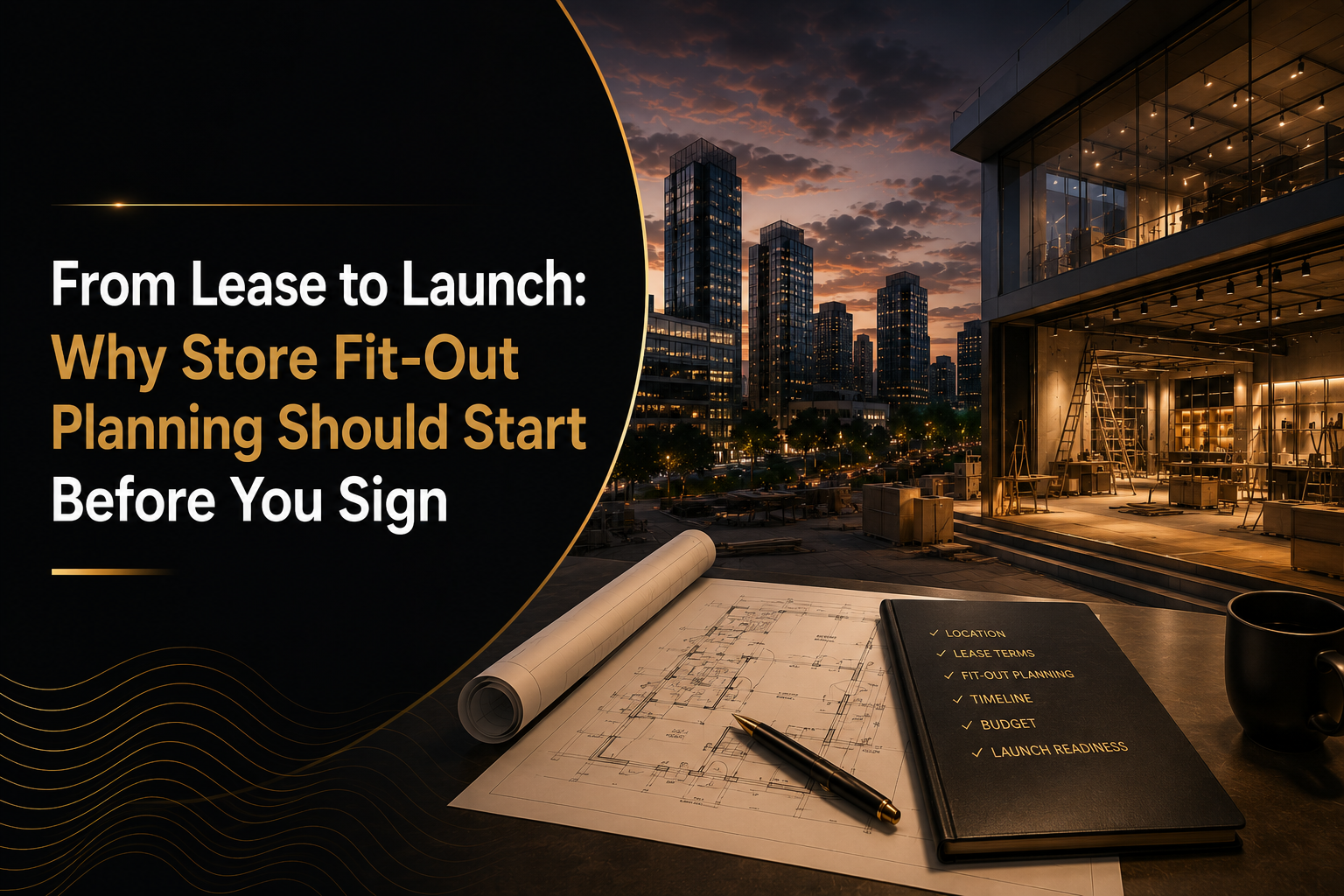
Most founders think fit-out starts after the lease is signed.
The space is finalised.
The agreement is done.
The keys are handed over.
Then the contractor is called.
But in reality, many fit-out problems begin much earlier.
They begin when the space is selected without checking the site condition properly.
They begin when the rent-free period is negotiated without understanding the work required.
For any brand opening a store, showroom, café, salon, clinic, wellness space or customer-facing commercial space in Hyderabad, fit-out planning should not begin after handover.
It should begin before the lease is signed.
Because the location, lease terms and store build are connected.
A good space can become difficult if the handover condition is weak.
A good lease can become expensive if the fit-out takes longer than expected.
A good rent-free period can be wasted if the site is not ready for work.
This is why store fit-out planning is not just a construction issue.
It is a commercial decision.
Fit-Out Is Not Just Interiors
Many founders use the word “interiors” when they talk about opening a store.
But a commercial fit-out is much more than interiors.
Interior design shapes how the store should look and feel.
Fit-out management protects how the store gets built, coordinated and opened.
Both are important, but they are not the same.
A designer may create the layout, finishes and visual direction. But the execution still needs civil work, electrical planning, lighting, HVAC, plumbing, flooring, ceiling, signage, vendor coordination, site supervision, landlord approvals and final readiness before launch.
The customer sees the finished space.
But the founder feels the fit-out process much earlier — through delays, cost changes, coordination issues and handover gaps.
That is why fit-out management should be planned as part of the expansion decision, not as a separate task after leasing.
The Site Condition Matters More Than It Seems
Two commercial spaces may look similar during a site visit.
Same area.
Similar size.
Comparable rent.
Good frontage.
But from a fit-out perspective, they may be completely different.
One space may already have usable electrical load.
Another may need major upgrades.
One space may have clear ceiling height.
Another may have beams, ducts or structural restrictions.
One space may allow easy material movement.
Another may have difficult loading access.
One space may be handed over in a clean shell condition.
Another may require demolition, waterproofing, flooring correction or landlord-side work before fit-out can even begin.
These differences affect cost and timeline.
In Hyderabad, especially across commercial pockets such as Banjara Hills, Jubilee Hills, Gachibowli, Hitec City, Kondapur, Kokapet and Financial District, commercial properties can vary widely in age, structure, access and handover quality.
A space that looks ready during the first visit may still have practical issues that only show up during execution.
That is why founders should evaluate the site condition before signing the lease.
Not after.
The Rent-Free Period Should Match the Work Required
The rent-free period is the time given to complete fit-out before rent begins.
But many brands negotiate the rent-free period without first understanding how much work the space actually needs.
This creates pressure.
A 30-day rent-free period may be enough for a light setup. But it may not be enough for a full retail showroom, wellness clinic, café, salon or store that needs civil changes, electrical work, plumbing, flooring, branding and approvals.
If the site is not handed over properly, even a good rent-free period can be wasted.
The founder may lose time waiting for landlord-side work.
Vendors may not be able to begin immediately.
Approvals may delay execution.
Material movement may be restricted.
Design changes may happen because the site was not studied properly.
By the time the store is ready, rent may have already started.
That is why the rent-free period should not be negotiated in isolation.
It should be reviewed along with the site condition, scope of work and realistic fit-out timeline.
Handover Clarity Can Prevent Delays
A smooth fit-out depends heavily on handover clarity.
Before signing the lease, founders should understand exactly what the landlord is handing over.
Some important questions include:
Will the space be handed over as a bare shell or warm shell?
Will electrical load be provided?
Will flooring be completed?
Will plumbing points be available?
Will the landlord complete any civil works before handover?
Will fire safety requirements be in place?
Will the signage area be ready?
Will there be access for labour, material and vendors?
Will work be allowed during required hours?
These questions may seem small during lease negotiation, but they become serious during fit-out.
If they are not clarified early, the founder may end up coordinating between the landlord, contractor, designer, electrician, plumber, signage vendor and building management after the lease is already signed.
That is when avoidable delays begin.
Why Fit-Out Planning Should Be Connected to Leasing
The most common mistake is treating leasing and fit-out as separate stages.
The broker helps with the space.
The lawyer reviews the lease.
The contractor comes in after handover.
The founder tries to connect everything.
By then, many decisions are already locked.
At Mir & Co., we look at fit-out planning as part of the larger commercial expansion decision.
Because the three parts affect each other.
The location decides what the store can achieve.
The lease decides what the brand is committing to.
The fit-out decides how quickly and practically the store can open.
When these are reviewed together, the decision becomes more realistic and better informed.
A founder is not only asking:
“Is this a good space?”
They are also asking:
“Can this space be leased, built, and opened properly within our timeline and budget?”
That is a much better question.
How Mir & Co. Supports Fit-Out Management and Turnkey Execution
Mir & Co. helps brands manage the store build after handover, either through complete turnkey execution or selective support across vendors, supervision, timelines, and launch readiness.
Our fit-out support is shaped by hands-on experience in building commercial complexes, coordinating storeexecution,n and working with local vendors and suppliers in Hyderabad.
That gives us a different lens.
We do not look at a space only as a leased property.
We do not look at it only as an interior concept.
We look at it as a site that has to be built, coordinated and opened within a real commercial timeline.
We look at the space from three connected perspectives:
Location suitability
Lease and handover terms
Fit-out execution feasibility
This helps brands understand:
What the space needs before opening
Whether the rent-free period is realistic
What handover condition should be clarified
Which vendor decisions need to be made early
How lease terms may affect execution
How to reduce gaps between handover and launch
The goal is not only to make the store look good.
The goal is to help the store open with fewer delays, fewer avoidable surprises and a more realistic execution plan.
Final Thought
Fit-out planning should not begin after the lease is signed.
By then, many decisions have already been made.
Before signing, founders should ask:
“Can this space be realistically built and opened within our timeline, budget and lease terms?”
That question can prevent avoidable delays, cost pressure and launch stress.
For brands entering or expanding in Hyderabad, the strongest store launches happen when location, lease and fit-out are reviewed together.
Planning a Store Fit-Out in Hyderabad?
Mir & Co. helps brands manage store fit-outs and turnkey execution with a practical understanding of commercial leasing, lease structuring, store build requirements and launch timelines.
From site condition review to vendor coordination and final handover, our role is to help brands move from lease to launch with fewer gaps and better-informed decisions.